

How To Set Up A Light Microscope Step By Step
Before You Offset
Familiarizing Yourself
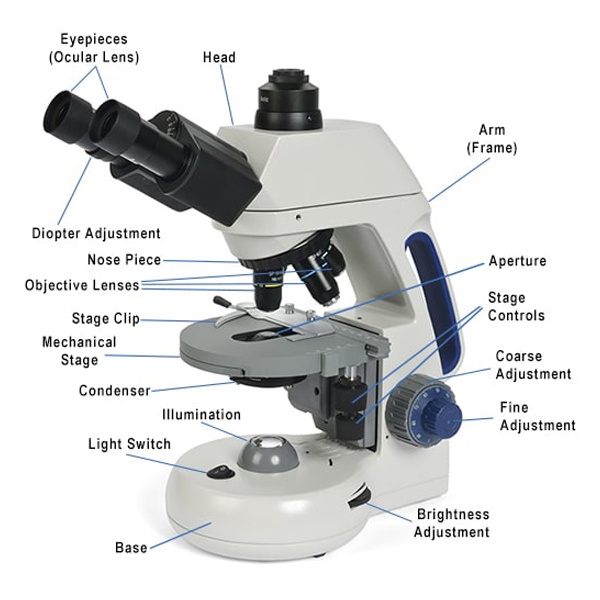
The commencement step is to get over all parts of the microscope and get a adept idea of where everything is and what everything does – especially any dials or other interactive features. This is best washed while standing in forepart of the microscope where you would normally use it, but you should also practice a "walk around" to view whatsoever features that are hidden from view when using the device.
Preparing Slides
Microscope slides should be prepared beforehand and should include a cover sideslip (plastic or glass, depending on your purpose and budget). If the objective lens should touch the slide (which should not happen anyhow of the device is used correctly, see below), these covers will prevent or minimize damage acquired. The "stage clips" should be used to secure the slide (and embrace) to the stage. Pushing downward in the dorsum end of these phase clips will open them.
Step by Pace – How to Use a Compound Microscope
- Turn the Objective Lenses so that the longest lens (the lowest ability one) is in viewing position. Be sure that at that place is room for it to move into identify. Lower the Mechanical stage to make more than room if needed.
- Identify the slide on the Mechanical stage and fasten it with the stage clips.
- Look at the side of the microscope and turn the Adjustment knob until the lens is very close to, only not touching, the slide.
- Wait through the eyepiece and movement the Adjustment knob so that the lens lifts away from the slide. The image should come into focus. Be careful not to drib the lens into the confront of the slide, as this may crusade damage to the lens.
- The condenser can exist adjusted to increase or decrease light intensity. You will usually want the most light possible for clearer viewing, but with depression power objective lenses you may need to decrease the light.
- The slide tin be moved effectually to center the desired paradigm in the field of view.
- Once you have a clear epitome with the low-ability objective, you may desire to switch to a higher power one by switching the objective lens. Because they are shorter, you don't demand to worry about turning them into the face of the slide and causing impairment. This is i of the reasons we start with the lower ones.
- You may demand to slightly adjust the focus and centering of the object you are viewing. If you try this, and it doesn't seem to come into focus, then driblet the lens to very near, but not touching, the slide (look from beside the microscope to do this, non through the eye piece) and then await through the eyepiece while you slowly heighten the lens away from the slide. At some indicate, it volition come into focus for you lot.
- When you take finished viewing the slide, lower the Mechanical phase using the Adjustment knob, click the depression power lens into viewing position (in preparation for next fourth dimension), and remove the slide (by pressing on the ends of the clips to release it).
Extra Tips and Tricks
- Here are some more useful tips to consider before using a microscope:
- When using a microscope with a unmarried eyepiece, it is practiced practice to keep the other eye open to avoid centre strain. Remember that the paradigm is flipped upside downward and horizontally when viewed through the microscope, so when moving it, it will announced to go the opposite way to what you might intend – moving the slide up makes the image move down, and moving the slide to the right makes the image move left, etc.
- Ready your slide with a protective coverslip.
- Practise not touch the middle glass function of the lenses with your fingers, just the edges. There is special lens newspaper for cleaning the lenses. You may want to apply gloves.
- Switch off the microscope when it is not in utilise.
- Always cover your microscope when not in use.
- Always use both easily when y'all acquit a microscope, with i mitt on the arm and the other under the base.
Larn more virtually microscopes with our other useful guides below:
- What is a compound microscope?
- What is a stereo microscope?
- What is a digital microscope?
- What is a fluorescence microscope?

How To Set Up A Light Microscope Step By Step,
Source: https://microscopeinternational.com/how-to-use-a-microscope/
Posted by: henryfark1951.blogspot.com
0 Response to "How To Set Up A Light Microscope Step By Step"
Post a Comment